Saturday, February 4, 2012

Newt’s New Frontier.

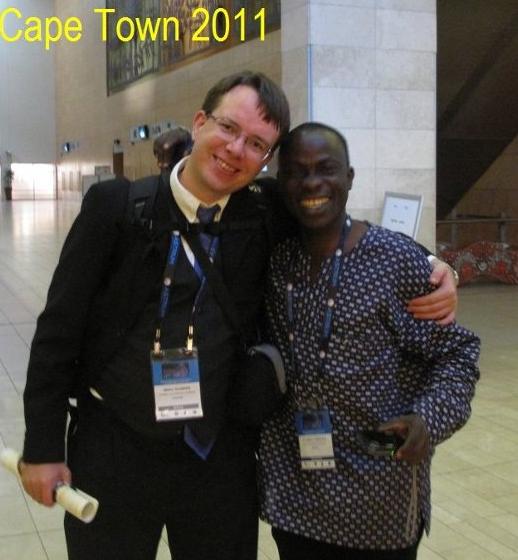
He is my friend and our class representative in the space studies program of International Space University, France in 2003. Recently, in 2011, we both had an opportunity to meet up again at the International Astronautical Congress in South Africa. It was a cool reunion, and as you may depict from the image below, we hold each other in very high esteem.
Mikko
Mikko Suominen is a highly respected Finnish space analyst. Little wonder, he responded to my re-post of Rick Tumlinson’s huffingtonpost on my fb wall, titled “Big ideas in small times”, written on Newt Gingrich’s new comments on space colony.
Mikko was right to emphasize the wave of critiques that followed Newt’s comment in a campaign train at the wake of winning supports in the State that somewhat could be referred to as the “mecca” of spaceflight in America. The retired US Space Shuttle program took off, and landed in Cape Canaveral, Florida, with the situated Kennedy Space Center of the NASA program well positioned nearby.

For GOP hopefuls, the State of Florida was a best place to hit on an ‘out of the box idea’ on space, ideas that have the potential of bringing back the lost jobs and more - a ray of hope that could be ignited. The space professionals and astronauts alike have their schedules shrunk as a result of the last launch of Atlantis STS-135 in July, 2011.

It was sound to say most politicians want to be like JFK. Why not? JFK was one of the greatest American Presidents, despite the fact that he was short-lived. He was an orator in the class of Marcus Tullius Cicero, friendly, finely educated, and most of all a leader with both vision and pragmatism. For a republican seeking party nomination to be knitting up a tie with the ideals of a die-hard democrat, tells about the gargantuan greatness of JFK and the reach of his legacy. It is therefore pertinent to hear a republican frontrunner of Mitt Romney said Newt isn’t “conservative” enough, solely because he trailed on a democrat’s ideal. Let’s be reminded that President Ronald Reagan was equally a space enthusiast. That isn’t a part of my interest here; the context of the idea proclaimed by Newt is what caught my fancy.

Absolutely! I agree with my friend, again, that Newt is appealing to national pride, and his motivation is just to fish for votes. However, what better way to fish for votes in a tensed-up campaign train, trying to consolidate on his recent South Carolina lead, and competing with a very wealthy Mitt. Mitt’s wealth, analysts have said, will rival one of the five richest Presidents of America, if elected, depending on how you rate. “Just how rich is Mitt Romney? Add up the wealth of the last eight presidents, from Richard Nixon to Barack Obama. Then double that number. Now you're in Romney territory.” For Sheldon Adelson, Newt might have been well crowded out – just on the power of money in politics. I like Mitt Romney a lot, I see him a fine gentleman properly educated, whose legacy as a Governor of Massachusetts speaks volume. He might give Obama a tough run for the White House if he secures his party nomination.

City of Cocoa on Florida Space Coast’s January 25 laid out plan of having an American-manned lunar colony in 2020 if elected cannot be said to be boastful of Newt, considering the fact that he is not a newcomer to space interest and policy. He has pretty good pedigree to that effect while serving in the House.
Former Speaker of the House Newt Gingrich
Although in JFK’s situation, you cannot distinctly say he nursed the idea for too long time before getting to execute it. However, when he had the idea he did subject it to a very extensive research with the technocrats and politicians alike, and for the impending necessity to beat the Soviet Union. And, in the JFK’s, it took space crisis, the race to push the Frontier.

For Newt to have come up with this idea in a time of opportunities, an idea to go mine the immense resources on the Moon for humanity here on Earth, or live on there, is worth commendation, irrespective of one’s political inclination. Moreover, the idea during the Apollo times was to get to the Moon and proceed further! After all, if this ideal had been pressed on with commitments from all and we are by now, a space colonizing world, nobody, not even Newt would have thought it’s worth a campaign statement.

I have this to say, we like it or not, the Moon, and, the vast space is the future of humanity. Our future lies there, in the Final Frontier. That’s the new challenge and we need the political will to forge ahead to this future. In a nutshell, “What Americans dream, Americans can do,” though this applies to all! But it’s time for America to do it again; the other Worlds too, are now setting their goals toward the “lunar far-side.” Doing it again is the best tribute to pay to Neil, Buzz and Mike, and of course, to the space explorers like the Columbia astronauts and others who lost their lives, and to the other living legends. 

Moon
On aspects of implementations, there is no one way to achieve that. In as much as New Space should push limits and President Obama’s idea has empowered companies like SpaceX; NASA’s guidance will still remain invaluable. X-Prize, a foundation of Peter Diamandis is leading a revolution of modern day incentivized prize competition, and as it regards the Moon, the Google Lunar X-Prize with 26 private teams vying for $30 Million has promising teams like Synergy Moon LLC, White Label Space and Moon Express in the pack. Hence, going back to the moon is underway.  However, I am glad Newt proposed a PPP approach, which means he considered the economies of this new idea, which in a sense, is an age-long idea given a new breath.

The whole seems laughable, is it because it has not been done before? What we need is the political will, leadership, management of the right technologies, and push, the kind that JFK provided. Hence, I do think extensive consultations should be like the times of JFK to fashion out the best approach-there’s no need for a rush, 2020 might just be unrealistic considering the present timeline in the US space program. Newt’s New Frontier: if nothing, romance that could be associated with space was brought back into the consciousness of space professionals.
Ad astra.
Ayodele Faiyetole

Tuesday, August 23, 2011

Space Studies Program 2011 Week 6 Teaching Associate Blog


The alumni weekend had come and gone, ushering in a fresh week of new activities. The participants woke up to the reality of a fast approaching deadline for submitting their Team Projects’ Letters of Intent to the director of SSP, Professor Angie Bukley, and most had sleepless night in order to accomplish the Monday, 15th August, 12 noon submission deadline.
Lustbuehel Observatory: the best BBQ location that never was
Until midnight before the beginning of the academic week, we’d all looked forward to enjoying the serenity and perfect BBQ location of Lustbuehel Observatory, a 15-minute bus-ride away from the Inffeld campus of TU Graz. The weather forecasters however had predicted a thunderstorm leading to the change in the BBQ venue to the on-campus social venue, the foyer of building 18.
A rainy Lustbuehel Observatory
The SatApps which DA8 was already planned for this observatory nonetheless proceeded, and had a great time, another opportunity of been led by the magnificent Otto Kouldelka, the chair of the TU-Graz local organizing committee, and Professor of Satellite Communications.
Lustbuehel Observatory is a satellite ground station, laser ranging station, interferometer, frequency laboratory, as well as astronomical telescope observatory. At the satellite ground station, bit error rate, and multiple access techniques including the code division multiple access are experimented on direct links to geostationary satellites. Austria has a rich history with respect to the development of spread spectrum technology. Hedy Lamarr was previously married to an Austrian munitions tycoon and on her presence at her husband’s business meetings, had thought to evade communication intrusion by the enemies; proposed carrier frequency could be hopped until the data reached the intended recipient(s). For this, Lamarr, an Austrian-born actress held a joint patent, Professor Kouldelka was very proud to remind us.
United Nations Office of Outer Space Affairs: Vienna International Centre
The long awaited professional visit to Vienna happened on Tuesday, 16th August. The day started a bit earlier than usual for the most of us as we had the buses leaving Graz at 0730; hence Mensa, the cafeteria, was opened for breakfast 0600 – 0715. The participants were grouped in the buses according to the other three professional visits planned: European Space Policy Institute, RUAG Space, and Siemens Space. We arrived at the Vienna International Centre, which inclusively houses the UN Office of Outer Space Affairs (OOSA) two and a half hours later.

Vienna International Center
Niklas Hedman, the Secretary of UN Committee on Peaceful Uses of Outer Space (COPUOS) and Director, Committee Services and Research Section in OOSA, took up the position of the Chairman to address the SSP11 delegation to a special session. He highlighted the history of OOSA relationship with the International Space University, with the latter enjoying a permanent observer status at all COPUOS meeting, both institutions focusing on global participation in space activities for peaceful purposes. The COPUOS Scientific Sub-Committee meeting held in February and the Legal Sub-Committee held March/April for two weeks a-piece; the COPUOS have the opportunity to review the activities of member states in the previous year in view of the Five United Nations Treaties and Five United Nations Principles on Outer Space. Thereafter, the Committee set the agenda to address future issues.

UN Special Session for SSP11 Participants

Werner Balogh and David Stevens of the Program on Space Applications Section and UN-SPIDER gave us a run through their activities. The United Nations Program on Space Applications was established in 1971 on the recommendation of the first United Nations Conference on the Exploration and Peaceful Uses of Outer Space (UNISPACE) that took place in Vienna in 1968. The United Nations Platform for Space-based Information for Disaster Management and Emergency Response (UN-SPIDER) program was however established as a result of the UN General Assembly’s December 2006 resolution. These both OOSA run programs have strings of achievements to their credit. Notable amongst these achievements is creating enabling platforms for the developing nations move from “space using” status to space faring nations.

SSP11 on the UN Terrace-A proud bunch!
Focus on the Departments ...
Business and management participants had an exciting and jam packed week. William Pomerantz (MSS '04), the Vice President for Special Projects at Virgin Galactic, gave two presentations to the Business and Management participants. In his first lecture, he spoke about the use of incentive prizes as a low cost, low risk means to conduct targeted research and development, drawing on the history of the $10 million Ansari X PRIZE. In a second, August 16 session, he discussed the promise and strengths of the emerging commercial space industry and on the phenomenon on space entrepreneurship. In both lectures, he described to the class how these two paradigms--incentive prizes and commercial human spaceflight--are an important parts of the aerospace ecosystem that complement more traditional industry players and processes.
The RFP presentation was made and the winners were announced. We had the pleasure of having Stefano Fiorilli (Head of Procurement, Human Spaceflight and Satellites at European Space Agency) attend for this last week of the department sessions.
Business & Management personnel with Stefano Fioriooi (second right).

Space and Society enjoyed collaborations in Week 6; beginning with a workshop on the Search for Extra-Terrestrial Intelligence led by visiting Space Physical Science lecturer, Dr. Vladimir Pletser. Next activity was the construction of the analog space habitat and the simulation of a lunar mission. This was an interdepartmental activity with the Systems Engineering department. Each participant had a role to play in developing and creating the habitat, followed by an opportunity to work alternately in Mission Control and on Mission in two simulations. It was a very lively session for the department and there was lots of work to do in learning to manage time and resources. There was just enough time left for the participants to finish their individual assessments - we had a range of topics including governance, funding, and psychological implications of missions to Mars, and new ideas for communicating space activities to new audiences.
Space & Society and Space Engineering build an analog space habitat.

Communications laboratory was put into operation and used by the SatApps to experiment with internet access by satellite, Voice over Internet Protocol, satellite telephony using Thuraya and multimedia services. Real geostationary communications satellite transponder with payloads in KU and KA bands was demonstrated. The departmental activities crescendos into (International Telecommunications Union) ITU Role Play, where the participants simulated the negotiating intricacies involved in obtaining required frequencies for satellite applications and learned the international coordination and regulation affecting spectrum issues. So sad to see it all ended at the department so we drew in to a close after the participants’ individual projects presentation with a party which registered smiles on all the faces.
Party time with Satellite Applications: participants and personnel.
Letting Loose and Going Wild ...
We had some great activities this week, but sometimes you have to let loose and go wild. For the second time, Alexandre Laurin championed the night of karaoke. Who knew we had such talents here!
Karaoke 2!

Bordered by Latvia, Russia Federation, Gulf of Finland, Baltic Sea (Sweden and Finland) and Lake Peipsi but on Saturday, August 20, Estonia was centered by France, Poland, India and (again) Sweden on the fifth group cultural night. Sweden got everyone cracking down laughing unexpectedly. India delighted with history on social engineers, Mahatma Ghandi, inventors, the Nobel laureates, and those beautiful people born on the surface of the world’s second most populous country, and of course, their “Michael Jackson’s” that caught the attentions of all.
Estonian Mart Vihmand doing his stuff.

And the war broke again, and again, some rebuilding, re-establishing of new governments, then the war broke again, and again, and finally Poland saved Europe from the incursion of the Turks, Michal Kracik had emphasized. Beyond the wars, I’d always asked myself, who can beat the styles, sophistication and simplicity of the French, not to talk of the French cuisine: good cheese, exquisite wine, champagne and organization. All these qualities were again demonstrated.
Wine tour group with Silberberg vinyards in the background.

Yes, the Styrian wine tasting was awesome. Welschriesling, Weiβburgunder, Sauvignon blanc, Traminer Schlossberg, Chardonnay brut and Zweigelt Cuvee are some of Silberberg proud wine. Peter Schrotter couldn’t have been more efficient organizing the trip, especially when we had to pass through his country home, HÖch to experience its tasty and filling local cuisine.
Now three more weeks extensively dedicated to the Team Projects are left in the Styrian province. Go on Week 7 and make the Teams prosper on their Projects.
Ad astra.
Ayodele Faiyetole