Wednesday, June 6, 2012

Tuesday, May 22, 2012
"Success! Falcon 9 Delivers Dragon to Orbit."
The Dawn of the Era of Private Human Spaceflight: Elon Musk, the new kid on the block, and his SpaceX team at about 3:44am, 22/5/2012 officially launched the new golden era of spaceflight with the successful launch of Falcon 9 ferrying the Dragon to the International Space Station. Go SpaceX... Go Elon...
(Liftoff video credit: SpaceX)
Thursday, May 3, 2012
Space Merchants and Planetary Mining
-
Click to read Space Merchants and Planetary Mining on The Huffington Post Science.
--
Click to read Space Merchants and Planetary Mining on The Huffington Post Science.
--
The world's
fossil fuels are in limited reserves and are also in quick depletion. In 2004
Lawrence A. Taylor, director of the U.S. Planetary Geosciences Institute,told the AFP, "Just 25 tonnes of helium, which can be
transported on a space shuttle, is enough to provide electricity for the U.S.
for one full year," noting that only 10 kilos of helium 3 are available on
Earth. He added, "By 2050 the whole world will have a major problem. We
need to be thinking ahead." Helium 3 is a potential pollution-free nuclear
fuel. It is believed that the Moon contains 10 times more energy (in the form
of helium 3) than all the fossil fuels on Earth.
The exhaustibility of mineral resources
on Earth and their almost infinite deposits on other planetary bodies in our
solar system are fast leading to the development of a whole new industry
spearheaded by exploratory-entrepreneurial visionaries. These space merchants,
like the British who prospected North America for tobacco plantations, believe
that space holds the best prospects for finding valuable minerals that could be
exploited for usage here on Earth and beyond.
Asteroid Mining
On April 24 at the Museum of Flight
in Seattle, Planetary Resources, Inc. made public its plan to mine near-Earth
asteroids (NEAs) for resources. Series of robotic probes and unmanned
spacecraft are to be launched, starting with their Arkyd-100 Earth-orbiting
telescopes, to prospect candidate NEAs. Subsequently, they plan to launch new
spacecraft to mine precious metals and extract water, which can be used for
fuel and life-support systems for onward space exploration by humans.
Considering the array of various
industry leaders backing this endeavor, it might as well be termed feasible and
a done deal even before the start. Financiers of the asteroid-mining venture
include Ross Perot, Jr. (chairman of Perot Systems) and Larry Page (CEO of
Google). Planetary Resources was founded in 2009 by Peter Diamandis and Eric
Anderson, who launched the phenomenon of "tourist astronauts" by
pioneering the space tourism business with their company, Space Adventure.
Backers of Planetary Resources include tourist astronaut Charles Simonyi,
Google executives Eric Schmitt and Ram Shriram, and billionaire filmmaker James
Cameron.
 |
| Asteroid Ida |
Diamandis said Planetary Resources "is establishing a new
paradigm for resource utilization that will bring the solar system within
humanity's economic sphere of influence by enabling low-cost robotic
exploration and eventual commercial development of asteroids." This is
certainly not the first time entrepreneurs are actively looking toward space
with bold plans to prospect, exploit, and utilize its resources.
Moon Mining
Moon Express, Inc. which Forbes
selected in 2011 as one of the 15 "Names You Need to Know," has made
known its interest in prospecting space for resources. On April 23 in Mountain
View, Calif., MoonEx, the leading contender for the Google Lunar X Prize,
announced that it had successfully delivered its Preliminary Design Checkpoint
Technical Package to NASA under its $10-million Innovative Lunar Demonstration
Data (ILDD) contract, providing NASA continuing data on the development of the
company's commercial lunar robotic missions and plans to mine the Moon for
precious resources. MoonEx was selected in 2010 for this contract, which is
granted only after technology is demonstrated, at the company's own risk.
Technology luminaries Naveen Jain (called the greatest entrepreneur on the
planet) and Barney Pell teamed up with space visionary Robert Richards to form
MoonEx in 2010. It is based at NASA Research Park in Silicon Valley.
In answering my question regarding
what similarities or distinctions exist between these planetary mining
companies, Richards said, "Basically, Moon Express plans to mine asteroids
too. The main difference is that MoonEx is planning to mine asteroidal material
on the Moon." He further expatiated on the rationale for the Moon, listing
reasons that included "proximity, shorter horizon, less risk, existing
technology, known destination sampling, and distributed materials."
Asteroids, he said, "are far, far away, longer horizon, high-risk, no
existing technology, no destination sampling, and concentrated materials."
From Richards' analysis, the Moon has clear advantages from both business and
technical perspectives.
Under a special partnership
agreement with NASA, MoonEx in a way has hired NASA to help create a small,
high-performance lunar lander system. "This will be launched starting from
as early as 2014," Richards said. If this launch date is accomplished, it
will be the first time a commercial company will travel out of the Earth's
orbit to another world.
The Gains to Humanity
No matter how difficult mining these
planetary objects might get, our corporate entities here on Earth are bound to
benefit hugely from this new space industry when it succeeds. As I stated
earlier, mineral resources are exhaustible, such that reserves here on Earth
are fast being depleted by continuous exploitation, causing a lot of resource
concerns. A new window to the infinite reserve of such minerals and more will
do humanity much good in terms of abundance and prosperity.
New direct industries will be
created and developed as a result of this planetary mining. In the past, space
activities relied heavily on measuring "spin-offs" when counting the
gains from space exploration, but this is bound to change. There is a huge
prospect of new metals to be mined, which may lead to whole new industries and
products and the driving down of product costs thanks to abundant supplies of
primary resources. As a result, new hands and skills will be needed and
developed, creating jobs for the entire economy.
Consciously
or unconsciously, the activities of these planetary miners may further open up
the final frontier and will enable human spaceflight. Planetary Resources
already noted that "water-rich NEAs will serve as
'stepping stones' for deep space exploration, providing space-sourced fuel and
water to orbiting depots. Accessing water resources in space will revolutionize
exploration and make space travel dramatically more economical."
In essence, mining planetary bodies
has both short- and long-term, known and unknown economic potential to meet
humanity's needs on Earth and for the development of outer space.
Ad astra.
Thursday, April 12, 2012
The Dawn of the Era of Private Human Spaceflight
Click to read The Dawn of the Era of Private Human Spaceflight on The Huffington Post Science
------
While visiting San Francisco awhile back, Yuki Takahashi was away at the South Pole working on a telescope for his Ph.D. He remotely organized for me to visit his laboratory in Berkeley where another telescope had been constructed by his team. Earlier on, as a Fulbright scholar in Glasgow, Yuki had written his master's thesis proposing a novel idea of placing a very low frequency radio array near the lunar South Pole; he received a special mention in the New Scientist. And in the fall of 2003, he was named the "Young Lunar Explorer" of the year. An award that International Space University received in 2004 -- partly for our 2003 Team Project, METZTLI: An ISS approach to Lunar Exploration, and our seven-person International Lunar Exploration Working Group task led by Yuki from Berkeley, and coordinated by me in Strasbourg. In 2002, at about the time of his master's thesis, definitely unbeknownst to Yuki, Space Exploration Technologies, a privately-owned company, was born. Yuki's infectious passion working on radio frequency and opening up the final frontier for humanity seemed it'd get realized faster than he had thought, at least not with the encumbrances associated with such in government-led ventures.
Under the guidance of Elon Musk, a "South African in Los Angeles" shaping multiple industries from sustainable energy with SolarCity to electric cars with Tesla Motors, his pragmatic instinct shoots beyond the sub-orbital, and makes the seemingly impossible possible with SpaceX; dreams of someday getting to the moon again, and beyond, to Mars, are getting clearer.
SpaceX is demonstrating an unparalleled ability in so many ways. The organization is similar only to institutions such as Langley Memorial Aeronautical Laboratory (now NASA Langley Research Center) of the aviation's "Second Golden Age." As described by Deborah Douglas, who served as Langley's visiting historian from 1994 to 1999, Langley had the ability to "attract bright young university graduates... [and] develop them into first-class research men." She continued, "For those who worked at Langley during this time: Can you imagine a more productive, interesting, challenging, exhilarating (and perhaps exhausting) time?" "Yukimoon" and the rest of the tireless SpaceX engineers working on the Falcon and the Dragon at SpaceX had spent weeks and months perfecting the enabling technologies to making Dragon able to meet up the deadlines of reaching the International Space Station. SpaceX was contracted in 2008 by NASA under its Commercial Orbital Transportation Services program to transport resupply to the astronauts on the ISS, since the U.S. Space Shuttle would get retired. Orbital Sciences Corp. is equally developing its own cargo freighter, Cygnus spacecraft under a $1.9 billion NASA contract.
In a somewhat real demonstration of what "dragons" are on the way to Mars, Robert Zubrin in his book, The Case for Mars, identified issues such as radiation, zero-g, human factors, dust storms and back contamination; in the same light, we may include reusable launchers and budgetary issues, which often intrude into, or blur out mission plans. The characteristic of the dragon was succinctly and scarily put by John in the book of Revelation as, "The great red dragon with seven dreaded heads, ten horns; having seven crowns upon its heads?" However, the Dragon from SpaceX is also great and characteristically an appearance of another wonder but this time, on Earth, going towards the stars of heaven and to be back to Earth sometime. It's a free-flying, fully recoverable capsule.
As a matter of fact, SpaceX's Dragon is built in such fashion to militate
against most of the seven dreads described by John and Bob. Very importantly,
SpaceX's Dragon has opportunities for radiation effects research, zero-g
research, and life science and biotech studies are available to the scientific
community. It has a highly responsive payload hosting, spacecraft development,
and space physics and relativity experiments. Among other possibilities are
Earth sciences and observations, materials and space environments research,
rendezvous and inspection, and robotic servicing.
The Dragon and the Falcon 9 that carries it is poised to have its first flight to the ISS soon as recently announced by SpaceX president Gwynne Shotwell, and for up to 12 unmanned flights at the first instance on a $1.6 billion NASA deal. Its mission is to enable humans to access the ISS by being a capable spacecraft designed for the low Earth orbit. The "DragonLab" is even manifesting further capability for non-ISS missions, with a vision for Mars. Other U.S. companies are equally developing their own private crewed spacecraft, some like SpaceX with NASA funding.
SpaceX seems to be perfecting both the technologies and the economics of rocket science. Falcon 9/Dragon system can carry seven astronauts to orbits -- more than double the capacity of the Russian Soyuz, but at less than a third of the price per seat. The Chinese market has continuously offered the most competitive prices in innovation. However this time, a Chinese government official noted, according to Aviation Week, at the National Space Symposium in Colorado Springs last year that "they find the published prices on the SpaceX website very low for the services offered, and concede they could not match them with the Long Mach series of launch vehicles." In May 2011, Elon stated that "for the first time in more than three decades, America last year began taking back international market-share in commercial satellite launch."
This is just the beginning. It is always inspiring listening to the "Iron Man" discussing issues relating to spaceflight. He is very passionate about helping make humans a "multiplanetary race." This he thinks possible, by developing Falcon 9 heavy launcher, with the capabilities similar only to Saturn V. Werner Von Braun, a former Nazi, whom the world celebrated his centennial anniversary posthumously on March 23, had led the development of this launcher used for the Apollo program. Elon has also recognized that for this new and "advanced race" to be possible, the Falcon 9 heavy launcher must be fully reusable, which will take it a step farther ahead of the Saturn V rocket. This we believe will be the game changer. The man's vision tears-off the normal comprehensible limits of human's imagination -- his dream is to carry men to Mars with his rockets, back to Earth, and to take off back to Mars in a routine, thereby fast emerging as the new Wilbur Wright of the "Wright Brothers," and he's a leading light of the pack who's leading Spaceflight's "Second Golden Age."
Safe flight to and from the ISS, Dragon, the journey to Mars is about to begin. To the World Space Party goers (Yuri's Night) tomorrow (April 12), and to the world at large, it's time to fasten our belts for "a whole new world" -- a phrase by Peabo Bryson -- Happy World Human Spaceflight Day. Ad Astra.
------
While visiting San Francisco awhile back, Yuki Takahashi was away at the South Pole working on a telescope for his Ph.D. He remotely organized for me to visit his laboratory in Berkeley where another telescope had been constructed by his team. Earlier on, as a Fulbright scholar in Glasgow, Yuki had written his master's thesis proposing a novel idea of placing a very low frequency radio array near the lunar South Pole; he received a special mention in the New Scientist. And in the fall of 2003, he was named the "Young Lunar Explorer" of the year. An award that International Space University received in 2004 -- partly for our 2003 Team Project, METZTLI: An ISS approach to Lunar Exploration, and our seven-person International Lunar Exploration Working Group task led by Yuki from Berkeley, and coordinated by me in Strasbourg. In 2002, at about the time of his master's thesis, definitely unbeknownst to Yuki, Space Exploration Technologies, a privately-owned company, was born. Yuki's infectious passion working on radio frequency and opening up the final frontier for humanity seemed it'd get realized faster than he had thought, at least not with the encumbrances associated with such in government-led ventures.
Under the guidance of Elon Musk, a "South African in Los Angeles" shaping multiple industries from sustainable energy with SolarCity to electric cars with Tesla Motors, his pragmatic instinct shoots beyond the sub-orbital, and makes the seemingly impossible possible with SpaceX; dreams of someday getting to the moon again, and beyond, to Mars, are getting clearer.
SpaceX is demonstrating an unparalleled ability in so many ways. The organization is similar only to institutions such as Langley Memorial Aeronautical Laboratory (now NASA Langley Research Center) of the aviation's "Second Golden Age." As described by Deborah Douglas, who served as Langley's visiting historian from 1994 to 1999, Langley had the ability to "attract bright young university graduates... [and] develop them into first-class research men." She continued, "For those who worked at Langley during this time: Can you imagine a more productive, interesting, challenging, exhilarating (and perhaps exhausting) time?" "Yukimoon" and the rest of the tireless SpaceX engineers working on the Falcon and the Dragon at SpaceX had spent weeks and months perfecting the enabling technologies to making Dragon able to meet up the deadlines of reaching the International Space Station. SpaceX was contracted in 2008 by NASA under its Commercial Orbital Transportation Services program to transport resupply to the astronauts on the ISS, since the U.S. Space Shuttle would get retired. Orbital Sciences Corp. is equally developing its own cargo freighter, Cygnus spacecraft under a $1.9 billion NASA contract.
In a somewhat real demonstration of what "dragons" are on the way to Mars, Robert Zubrin in his book, The Case for Mars, identified issues such as radiation, zero-g, human factors, dust storms and back contamination; in the same light, we may include reusable launchers and budgetary issues, which often intrude into, or blur out mission plans. The characteristic of the dragon was succinctly and scarily put by John in the book of Revelation as, "The great red dragon with seven dreaded heads, ten horns; having seven crowns upon its heads?" However, the Dragon from SpaceX is also great and characteristically an appearance of another wonder but this time, on Earth, going towards the stars of heaven and to be back to Earth sometime. It's a free-flying, fully recoverable capsule.
 |
| Dragon (Photo credit: SpaceX) |
The Dragon and the Falcon 9 that carries it is poised to have its first flight to the ISS soon as recently announced by SpaceX president Gwynne Shotwell, and for up to 12 unmanned flights at the first instance on a $1.6 billion NASA deal. Its mission is to enable humans to access the ISS by being a capable spacecraft designed for the low Earth orbit. The "DragonLab" is even manifesting further capability for non-ISS missions, with a vision for Mars. Other U.S. companies are equally developing their own private crewed spacecraft, some like SpaceX with NASA funding.
SpaceX seems to be perfecting both the technologies and the economics of rocket science. Falcon 9/Dragon system can carry seven astronauts to orbits -- more than double the capacity of the Russian Soyuz, but at less than a third of the price per seat. The Chinese market has continuously offered the most competitive prices in innovation. However this time, a Chinese government official noted, according to Aviation Week, at the National Space Symposium in Colorado Springs last year that "they find the published prices on the SpaceX website very low for the services offered, and concede they could not match them with the Long Mach series of launch vehicles." In May 2011, Elon stated that "for the first time in more than three decades, America last year began taking back international market-share in commercial satellite launch."
This is just the beginning. It is always inspiring listening to the "Iron Man" discussing issues relating to spaceflight. He is very passionate about helping make humans a "multiplanetary race." This he thinks possible, by developing Falcon 9 heavy launcher, with the capabilities similar only to Saturn V. Werner Von Braun, a former Nazi, whom the world celebrated his centennial anniversary posthumously on March 23, had led the development of this launcher used for the Apollo program. Elon has also recognized that for this new and "advanced race" to be possible, the Falcon 9 heavy launcher must be fully reusable, which will take it a step farther ahead of the Saturn V rocket. This we believe will be the game changer. The man's vision tears-off the normal comprehensible limits of human's imagination -- his dream is to carry men to Mars with his rockets, back to Earth, and to take off back to Mars in a routine, thereby fast emerging as the new Wilbur Wright of the "Wright Brothers," and he's a leading light of the pack who's leading Spaceflight's "Second Golden Age."
Safe flight to and from the ISS, Dragon, the journey to Mars is about to begin. To the World Space Party goers (Yuri's Night) tomorrow (April 12), and to the world at large, it's time to fasten our belts for "a whole new world" -- a phrase by Peabo Bryson -- Happy World Human Spaceflight Day. Ad Astra.
Friday, March 23, 2012
Ushering in the Final Frontier
Read "Ushering in the Final Frontier -- Manned Spaceflight" on The Huffington Post Science.
---
"I am a friend, comrades, a
friend!" Those were the first words from the "Columbus of the
Cosmos" Russian astronaut Yuri Gagarin, to a woman and a girl near where
his capsule landed on April 12, 1961. Mankind's first giant leap took place on
this day, which was a very huge one. It is even fast assuming an extremely
significant relevance on the space calendar vis-à-vis the future of humanity
beyond the Earth's atmosphere.
 |
| Yuri Gagarin - Citizen of the Universe |
Exactly twenty years after this
flight, on April 12, 1981, the American Space Shuttle program had its first;
Columbia STS-1 launched astronauts John W. Young, an Apollo veteran -- the
ninth person to walk on the moon in 1972, and Robert L. Crippen to Space. April
12 wasn't particularly chosen for this launch, but the original planned date
had slipped off for technical issues. Until their retirement with Atlantis
STS-135 in the third quarter of 2011, these reusable space vehicles were the
flagship of manned spaceflight since the Apollo times.
Twenty years after the launch of
STS-1, and forty years after Yuri's flight, in 2001, "Yuri's Night"
was started to commemorate this flight of the Columbus of the Cosmos, and to
mark this launch of Columbia. It will be held on April 12 across the globe by
space enthusiasts and institutions, essentially in the U.S., and the Russian
Federation. And I am proud to mention here that the co-founder of this
spectacular night, Loretta Hidalgo-Whiteside was the recipient of the maiden
Todd B. Hawley Visionary Award in 2005.
The International Space University
with its permanent site in Strasbourg, France, has been the academic home of
space professionals, and training ground for emerging space leaders across the
globe. ISU's first program, the space studies program, practically modeled
after "manned spaceflight" -- of leaving the base to some
destinations -- with its unprecedented 'on-Earth' and 'off-Earth' yearly SSP
sites, started in MIT and has moved to most continents of the world. It was
founded by its three visionaries: Peter H. Diamandis, Todd B. Hawley and Robert
D. Richards in 1987. The institution's ever-lasting credo was written out by
these visionaries on April 12, 1995.
This year, ISU celebrates her 25th
year -- the silver jubilee of actively producing space leaders that have gone
ahead to shape the future of space programs and activities on Earth and in the
cosmos around. Talking here about the cosmos -- at the 2040 horizon, ISU is
even more determined to establish the "off-Earth campus to form a core
element of the University's educational and societal actions related to
exploration and technology development."
Just a few years ago, specifically,
in 2007, the international space community led by the United Nations
commemorated 50 years of active space exploration -- marking the launch of the
first satellite, the Russian SPUTNIK-1 which was launched into space in 1957
(also, International Geophysical Year) heralding the beginning of the Space
Age. Serving as a National Coordinator for Education and Public Outreach of
this UN-led program, International Heliophysical Year, I marked April 12, and
explored the ideals of "scientific but people-oriented education, SPOE:
Art and Humanities in Science and Technologies" -- a concept I formulated.
A scientific education and outreach program was organized for a public model
school in Lagos, Nigeria, captured in a national daily. And in collaboration
with Stanford University, live research equipment was demonstrated for the
students - educating them about the sun, manned spaceflight and exploration. I
taught them about the encompassing nature of knowledge; and therefore softened
the science with art. The students received talk on world citizenry, career
possibilities that culminated in a Q & A session. We went ahead to dance to
popular local tunes! And the results? The students got inspired -- they wanted
to become everything from astronauts, to surgeons, engineers, scientists, and
even a "space artist." Some of them are already in some leading
universities preparing for their dream careers, and are being guided under the
Young EarthSpace Scientists (YESS) program.
There's an emergence of a new manned
space order. The perfect docking between Shenzhou-8 and Tiangong-1 (a prototype
space station) in 2011 has laid a perfect foundation for manned spaceflight in
China. Shenzhou-9 is expected to launch the first people to its "Heavenly
Palace," the crew may include the first female taikonaut in the third
quarter of this year, Niu Hongguang, deputy commander-in-chief of the country's
manned space program recently declared. This number will be joining the six
Chinese astronauts launched on three missions to orbits starting with Yang
Liwei, on Shenzhou-5 mission.
India has been really inspiring too,
with their novel scientific satellites and vehicular programs also shooting for
the moon. New opportunities are now open to all; even African nations now have
recognizable participation in small satellites, astronomy and, after sixty
years of the IAC, held its first congress in Africa last year.
We are
indeed in a golden era of active space exploration. The science research
community now has unprecedented opportunities to contribute to international
standard research. The ISS is delivering dividends to its owners and by
extension to the scientific community worldwide. There is an emerging sub-orbital
industry. Private companies are now venturing beyond the sub-orbital --
building rockets that may reach the other planetary bodies. Elon Musk is set to be the first
entrepreneur to put a man
in orbit. What exciting times we are in.
To take a cue from the foremost
rocketry theorist, Konstantin Eduardovich Tsiolkovsky, who lived from 1857 to
1935: "Earth is the cradle of humanity, but one cannot live in the cradle
forever."
In essence, to usher in this next
future --the final frontier -- these three significant occurrences of Yuri's
flight, launch of STS-1, and the founding of ISU are enough to seal the 12th of
April as the "World Manned Spaceflight Day". This could mean having a
more holistic program planned for this day, every year, programs that could
encompass the ideals of manned spaceflight, exploration and education, etc., in
the daytime. And of course, further popularize the social event of Yuri's
Night, which has done so greatly in making this day very popular worldwide.
This is not to undermine the UN-supported "World Space Week" of October
4, which technically marked the launch of SPUTNIK-1. Space is vast, and in
order for humans to further take the giant leaps of colonizing the other
planets -- terraforming and living on there -- we need to ensure the growth of
humans into multiplanetary beings and some more emphasis has to be paid to
manned spaceflight. We can start by dedicating April 12 of every year to manned
spaceflight in its entirety. Ad Astra.
Tuesday, February 28, 2012
Sunday, February 12, 2012
The Sun is quasi exhaustible, and the Renewable Energy issues!
Sometime ago, His Excellency, the Governor of
Lagos State, Mr. Babatunde Raji Fashola (SAN) published a thought provoking
piece captured, “is the sun inexhaustible?” His Excellency asked a critical
question, considering the global campaign for alternative energy to fossil fuel
use and the increasing adoption of solar energy by nations across the world,
including the developing nations. I, however, have being a proponent of
directly depending on the Sun for our energy needs; hence, His Excellency’s
question got me thinking. So, is the Sun really, inexhaustible?
By general opinion, nothing lasts forever,
which is a major reason why some schools of thoughts are asking for less
dependence on the exhaustible fossil fuel. On a lighter note, going by the
title of Sydney Sheldon’s 1994 bestselling novel, “Nothing lasts forever”. Simply, in that light, the Sun is exhaustible!
And according to astrophysicists and cosmologists, too, the Sun is exhaustible!
In the Universe, the Sun takes a pivotal
position in the configuration of the Solar System, and a member of our galaxy
called the Milky Way. Coupled with the increasing dependence on the Sun for our
energy needs worldwide, the Sun is bound to enjoy increasing popularity amongst
the different objects in the outer space in years to come. What about the other
stars? Stars are born, and as we all know, for anything that is born, death is
inevitable. This implies it has life and the life passes away with time. The
earliest stars were formed out of particles like hydrogen and helium just a
hundred million years after the Big Bang! The earliest stars seem to have been
10 and more than 100 times more massive than the Sun. The crushing pressure in
their cores made them burn through their nuclear fuel in only a few million
years. However, the death of these mega stars gave way to the formation of the
normal stars, and it heralded the Dark Age.
 |
| Photo credit: NASA |
This present generation of stars is more
sedated than the earliest ones. The Sun is just another star in our Milky Way
galaxy and the Earth happens to be one of the planets revolving around it as
part of the solar system. The Sun therefore affects our environment more than
the other stars in our galaxy; hence more than the other stars in the Universe.
The yet to be unraveled concept, though, is how much our environment affects
the Sun. At any rate, even the fossil fuel is formed in the Earth’s crust as a
result of the Sun energy input onto our environment.
 |
| Photo credit: NASA |
Aside from lighting up our fragile Earth,
according to a colleague from the Innovations to Society, “nearly all energy
forms used on Earth are, either directly or indirectly, based on solar energy,
the most prominent being fossil fuels, biomass, wind, hydro energy, and tidal.”
Solar energy can be directly converted into electricity in several ways. This
gives the biggest hope as an alternative energy source, and it is unarguably
the cleanest source of energy. The Sun consists entirely of gaseous materials,
primarily hydrogen and helium, mixed with trace amounts of carbon, nitrogen and
oxygen. The surface of the Sun is about 5550 degrees Celsius. Above the
surface, the temperature rapidly increases up to several million degrees. This
causes most elements to lose all their electrons, forming an electrically
conducting gas called plasma. As mentioned, the earliest stars spent just about
a million years to get burned out. The Sun will also burn out like other stars;
hence, the Sun is exhaustible.
 |
| Photo credit: Stanford Solar Center |
However, the Sun should still have about 5
billion years; having survived 5 billion years so far! Not all stars have this
length of years to spend though. This fact should allay any concern about using
up the energy from the Sun any time soon. Hence, the Sun is rather, quasi
exhaustible! Its supply is awesomely abundant. In fact, using up the energy
from the Sun means the end of the Earth, just because even the foods we eat all
source their energy directly or indirectly from the Sun. So tapping directly
into the energy from the Sun for alternative energy purposes to any degree of
usage does not affect the intensity of the Sun or even the reserves of the
particles that make up the Sun. And whether we turn away from using the Sun for
our renewable energy purposes, the intensity of the Sun or its reserves of
particles are not affected. Therefore, recourse to solar energy as an
alternative to fossil fuel is in line, and it is the best thing that will
happen in the energy industry worldwide. The direct conversion of the solar
energy from the Sun into usable energy is the only true renewable source on
Earth.
As such, falling on the Sun as our direct
source of energy has no negative impact on our environment, this is the only
reason why we advise that we tap directly into the Sun. The issue of global
warming (climate change) is anchored principally on using energy sources that
produce greenhouse gasses, which are carbon dioxide, methane, nitrous oxide,
perfluorocarbons, hydrofluorocarbons, sulphur hexafluoride and ozone depleting
substances; sulphur hexafluoride and ozone depleting lsubstances;
chloroflurorocarbons, hydrochloroflurocarbons, and halons. The human-induced
radiative forcing of the Earth’s climate is largely due to the increases in
these concentrations. The ozone layer absorbs the ultraviolet radiation from
the Sun. The greenhouse gases absorb infrared heat radiation from the ground.
These greenhouse gases are a stabilizing factor in maintaining the temperature
of the Earth’s atmosphere. Some of the greenhouse gases are also capable of
depleting the ozone layer, making the Earth prone to the direct penetration of
the ultraviolet radiation.
 |
| Cars and turbines in Sun |
The excessive increase in greenhouse gases can
contribute to warming up the Earth’s atmosphere, melting away the ice in the
Arctic, raising the water levels in the Atlantic Ocean, partially leading to
the extinction of many species, and more dangerously, the shortage of food
worldwide could be linked to it. Bush burning and poor solid waste disposal can
also lead to excessive production of greenhouse gases. So, the efforts being
made toward control of forestry/bush burning and proper solid waste disposal are
in line. However, the predominant sources of the increase are from the
combustion of fossil fuels, which principally release carbon dioxide. The
atmospheric carbon dioxide has increased by over 10% from 1980s according to Intergovernmental Panel on Climate Change. This is alarming. Therefore, Africa
can only get warmer by the continuous burning of fossil fuel worldwide, whether
in Acapulco, or San Francisco, Shenzhen or Tokyo, Port Harcourt or Accra, or in
Toulouse or London. In essence, the car that is built to run on fossil fuels in
Bavaria but driven in faraway Ontario affects our climate here in Lagos. The
warming is global as much as it is local. However, during the past 5 billion
years, the Earth has gone through climate changes over and over again. The
formless Earth at the beginning has alternatively experienced ice and warm
periods. But as the challenge of an ice or warm period is being faced, we’d
need to proactively find an immediate solution to balance up the temperature
while looking ahead. In a nutshell, the developing nations must start to work
just as the developed nations are continuously working. Fossil fuel, biofuels
and most other sources of energy are indirectly created by the Sun. The Sun is
the single most abundant source of renewable energy. The current growth rate of
using solar energy is low because the initial cost is prohibitive, and some
more advances need be made in the area of solar capture efficiency in order to
be able to capture a larger fraction of the solar spectrum. A breakthrough is
however, in view.
 |
| Ayodele Faiyetole |
It is possible though that some of the so
called renewable energy sources are much more damaging to the environment than
the orchestrated damages caused by fossil fuel. In this light, I will agree
with His Excellency, the Governor of Lagos State that proper weighing of the
pros and cons, both short and long term of whichever alternative source(s) we
are adopting needs to be exhaustive before we decide.
Ad astra.
Ayodele Faiyetole
--------------------
A part of this article first appeared in The Punch in January 2009. This full text was requested for, and published by Lagos Indicator-a publication dedicated to the State Government, for its Governors' Global Climate Summit edition, held in Los Angeles from Sept. 30th-Oct. 2nd, 2009.
Saturday, February 4, 2012
Newt’s New Frontier.
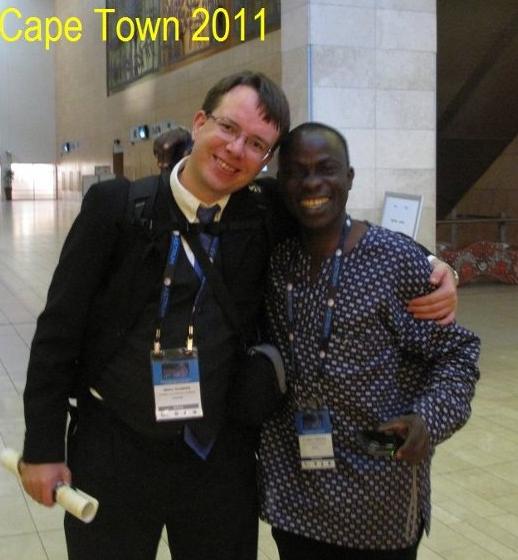
He is my friend and our class
representative in the space studies program of International Space University,
France in 2003. Recently, in 2011, we both had an opportunity to meet up again
at the International Astronautical Congress in South Africa. It was a cool
reunion, and as you may depict from the image below, we hold each other in
very high esteem.
Mikko Suominen is a highly respected
Finnish space analyst. Little wonder, he responded to my re-post of Rick
Tumlinson’s huffingtonpost on my fb wall, titled “Big ideas in small times”,
written on Newt Gingrich’s new comments on space colony.
 |
| Mikko |
Mikko was right to emphasize the wave of
critiques that followed Newt’s comment in a campaign train at the wake of winning
supports in the State that somewhat could be referred to as the “mecca” of
spaceflight in America. The retired US Space Shuttle program took off, and
landed in Cape Canaveral, Florida, with the situated Kennedy Space Center of
the NASA program well positioned nearby.
For GOP hopefuls, the State of Florida was
a best place to hit on an ‘out of the box idea’ on space, ideas that have the
potential of bringing back the lost jobs and more - a ray of hope that could be
ignited. The space professionals and astronauts alike have their schedules
shrunk as a result of the last launch of Atlantis STS-135 in July, 2011.
It was sound to say most politicians want
to be like JFK. Why not? JFK was one of the greatest American Presidents,
despite the fact that he was short-lived. He was an orator in the class of Marcus
Tullius Cicero, friendly, finely educated, and most of all a leader with both vision
and pragmatism. For a republican seeking party nomination to be knitting up a
tie with the ideals of a die-hard democrat, tells about the gargantuan greatness
of JFK and the reach of his legacy. It is therefore pertinent to hear a
republican frontrunner of Mitt Romney said Newt isn’t “conservative” enough,
solely because he trailed on a democrat’s ideal. Let’s be reminded that
President Ronald Reagan was equally a space enthusiast. That isn’t a part of my
interest here; the context of the idea proclaimed by Newt is what caught my
fancy.
Absolutely! I agree with my friend, again,
that Newt is appealing to national pride, and his motivation is just to fish
for votes. However, what better way to fish for votes in a tensed-up campaign
train, trying to consolidate on his recent South Carolina lead, and competing
with a very wealthy Mitt. Mitt’s wealth, analysts have said, will rival one of
the five richest Presidents of America, if elected, depending on how you rate.
“Just how rich is Mitt Romney? Add up the wealth of the last eight presidents,
from Richard Nixon to Barack Obama. Then double that number. Now you're in
Romney territory.” For Sheldon Adelson, Newt might have been well crowded out –
just on the power of money in politics. I like Mitt Romney a lot, I see him a
fine gentleman properly educated, whose legacy as a Governor of Massachusetts
speaks volume. He might give Obama a tough run for the White House if he
secures his party nomination.
City of Cocoa on Florida Space Coast’s
January 25 laid out plan of having an American-manned lunar colony in 2020 if
elected cannot be said to be boastful of Newt, considering the fact that he is
not a newcomer to space interest and policy. He has pretty good pedigree to
that effect while serving in the House.
 |
| Former Speaker of the House Newt Gingrich |
Although in JFK’s situation, you cannot
distinctly say he nursed the idea for too long time before getting to execute
it. However, when he had the idea he did subject it to a very extensive
research with the technocrats and politicians alike, and for the impending
necessity to beat the Soviet Union. And, in the JFK’s, it took space crisis,
the race to push the Frontier.
For Newt to have come up with this idea in a
time of opportunities, an idea to go mine the immense resources on the Moon for
humanity here on Earth, or live on there, is worth commendation, irrespective
of one’s political inclination. Moreover, the idea during the Apollo times was
to get to the Moon and proceed further! After all, if this ideal had been
pressed on with commitments from all and we are by now, a space colonizing
world, nobody, not even Newt would have thought it’s worth a campaign
statement.
I have this to say, we like it or not, the
Moon, and, the vast space is the future of humanity. Our future lies there, in
the Final Frontier. That’s the new challenge and we need the political will to
forge ahead to this future. In a nutshell, “What Americans dream, Americans can
do,” though this applies to all! But it’s time for America to do it again; the
other Worlds too, are now setting their goals toward the “lunar far-side.”
Doing it again is the best tribute to pay to Neil, Buzz and Mike, and of
course, to the space explorers like the Columbia astronauts and others who lost
their lives, and to the other living legends.
 |
| Moon |
On aspects of implementations, there is no
one way to achieve that. In as much as New Space should push limits and
President Obama’s idea has empowered companies like SpaceX; NASA’s guidance
will still remain invaluable. X-Prize, a foundation of Peter Diamandis is
leading a revolution of modern day incentivized prize competition, and as it
regards the Moon, the Google Lunar X-Prize with 26 private teams vying for $30
Million has promising teams like Synergy Moon LLC, White Label Space and Moon
Express in the pack. Hence, going back to the moon is underway. However, I am glad Newt proposed a PPP
approach, which means he considered the economies of this new idea, which in a
sense, is an age-long idea given a new breath.
The whole seems
laughable, is it because it has not been done before? What we need is the
political will, leadership, management of the right technologies, and push, the
kind that JFK provided. Hence, I do think extensive consultations should be
like the times of JFK to fashion out the best approach-there’s no need for a
rush, 2020 might just be unrealistic considering the present timeline in the US
space program. Newt’s New Frontier: if nothing, romance that could be
associated with space was brought back into the consciousness of space professionals.
Ad astra.
Ayodele Faiyetole
Ad astra.
Ayodele Faiyetole
Tuesday, August 23, 2011
Space Studies Program 2011 Week 6 Teaching Associate Blog
The alumni weekend had come and gone, ushering in a fresh week of new activities. The participants woke up to the reality of a fast approaching deadline for submitting their Team Projects’ Letters of Intent to the director of SSP, Professor Angie Bukley, and most had sleepless night in order to accomplish the Monday, 15th August, 12 noon submission deadline.
Lustbuehel Observatory: the best BBQ location that never was
Until midnight before the beginning of the academic week, we’d all looked forward to enjoying the serenity and perfect BBQ location of Lustbuehel Observatory, a 15-minute bus-ride away from the Inffeld campus of TU Graz. The weather forecasters however had predicted a thunderstorm leading to the change in the BBQ venue to the on-campus social venue, the foyer of building 18.
 |
| A rainy Lustbuehel Observatory |
The SatApps which DA8 was already planned for this observatory nonetheless proceeded, and had a great time, another opportunity of been led by the magnificent Otto Kouldelka, the chair of the TU-Graz local organizing committee, and Professor of Satellite Communications.
Lustbuehel Observatory is a satellite ground station, laser ranging station, interferometer, frequency laboratory, as well as astronomical telescope observatory. At the satellite ground station, bit error rate, and multiple access techniques including the code division multiple access are experimented on direct links to geostationary satellites. Austria has a rich history with respect to the development of spread spectrum technology. Hedy Lamarr was previously married to an Austrian munitions tycoon and on her presence at her husband’s business meetings, had thought to evade communication intrusion by the enemies; proposed carrier frequency could be hopped until the data reached the intended recipient(s). For this, Lamarr, an Austrian-born actress held a joint patent, Professor Kouldelka was very proud to remind us.
United Nations Office of Outer Space Affairs: Vienna International Centre
The long awaited professional visit to Vienna happened on Tuesday, 16th August. The day started a bit earlier than usual for the most of us as we had the buses leaving Graz at 0730; hence Mensa, the cafeteria, was opened for breakfast 0600 – 0715. The participants were grouped in the buses according to the other three professional visits planned: European Space Policy Institute, RUAG Space, and Siemens Space. We arrived at the Vienna International Centre, which inclusively houses the UN Office of Outer Space Affairs (OOSA) two and a half hours later.
 |
| Vienna International Center |
Niklas Hedman, the Secretary of UN Committee on Peaceful Uses of Outer Space (COPUOS) and Director, Committee Services and Research Section in OOSA, took up the position of the Chairman to address the SSP11 delegation to a special session. He highlighted the history of OOSA relationship with the International Space University, with the latter enjoying a permanent observer status at all COPUOS meeting, both institutions focusing on global participation in space activities for peaceful purposes. The COPUOS Scientific Sub-Committee meeting held in February and the Legal Sub-Committee held March/April for two weeks a-piece; the COPUOS have the opportunity to review the activities of member states in the previous year in view of the Five United Nations Treaties and Five United Nations Principles on Outer Space. Thereafter, the Committee set the agenda to address future issues.
 |
| UN Special Session for SSP11 Participants |
Werner Balogh and David Stevens of the Program on Space Applications Section and UN-SPIDER gave us a run through their activities. The United Nations Program on Space Applications was established in 1971 on the recommendation of the first United Nations Conference on the Exploration and Peaceful Uses of Outer Space (UNISPACE) that took place in Vienna in 1968. The United Nations Platform for Space-based Information for Disaster Management and Emergency Response (UN-SPIDER) program was however established as a result of the UN General Assembly’s December 2006 resolution. These both OOSA run programs have strings of achievements to their credit. Notable amongst these achievements is creating enabling platforms for the developing nations move from “space using” status to space faring nations.
 |
| SSP11 on the UN Terrace-A proud bunch! |
Business and management participants had an exciting and jam packed week. William Pomerantz (MSS '04), the Vice President for Special Projects at Virgin Galactic, gave two presentations to the Business and Management participants. In his first lecture, he spoke about the use of incentive prizes as a low cost, low risk means to conduct targeted research and development, drawing on the history of the $10 million Ansari X PRIZE. In a second, August 16 session, he discussed the promise and strengths of the emerging commercial space industry and on the phenomenon on space entrepreneurship. In both lectures, he described to the class how these two paradigms--incentive prizes and commercial human spaceflight--are an important parts of the aerospace ecosystem that complement more traditional industry players and processes.
The RFP presentation was made and the winners were announced. We had the pleasure of having Stefano Fiorilli (Head of Procurement, Human Spaceflight and Satellites at European Space Agency) attend for this last week of the department sessions.
 |
| Business & Management personnel with Stefano Fioriooi (second right). |
Space and Society enjoyed collaborations in Week 6; beginning with a workshop on the Search for Extra-Terrestrial Intelligence led by visiting Space Physical Science lecturer, Dr. Vladimir Pletser. Next activity was the construction of the analog space habitat and the simulation of a lunar mission. This was an interdepartmental activity with the Systems Engineering department. Each participant had a role to play in developing and creating the habitat, followed by an opportunity to work alternately in Mission Control and on Mission in two simulations. It was a very lively session for the department and there was lots of work to do in learning to manage time and resources. There was just enough time left for the participants to finish their individual assessments - we had a range of topics including governance, funding, and psychological implications of missions to Mars, and new ideas for communicating space activities to new audiences.
 |
| Space & Society and Space Engineering build an analog space habitat. |
Communications laboratory was put into operation and used by the SatApps to experiment with internet access by satellite, Voice over Internet Protocol, satellite telephony using Thuraya and multimedia services. Real geostationary communications satellite transponder with payloads in KU and KA bands was demonstrated. The departmental activities crescendos into (International Telecommunications Union) ITU Role Play, where the participants simulated the negotiating intricacies involved in obtaining required frequencies for satellite applications and learned the international coordination and regulation affecting spectrum issues. So sad to see it all ended at the department so we drew in to a close after the participants’ individual projects presentation with a party which registered smiles on all the faces.
 |
| Party time with Satellite Applications: participants and personnel. |
Letting Loose and Going Wild ...
We had some great activities this week, but sometimes you have to let loose and go wild. For the second time, Alexandre Laurin championed the night of karaoke. Who knew we had such talents here!
We had some great activities this week, but sometimes you have to let loose and go wild. For the second time, Alexandre Laurin championed the night of karaoke. Who knew we had such talents here!
 |
| Karaoke 2! |
Bordered by Latvia, Russia Federation, Gulf of Finland, Baltic Sea (Sweden and Finland) and Lake Peipsi but on Saturday, August 20, Estonia was centered by France, Poland, India and (again) Sweden on the fifth group cultural night. Sweden got everyone cracking down laughing unexpectedly. India delighted with history on social engineers, Mahatma Ghandi, inventors, the Nobel laureates, and those beautiful people born on the surface of the world’s second most populous country, and of course, their “Michael Jackson’s” that caught the attentions of all.
 |
| Estonian Mart Vihmand doing his stuff. |
And the war broke again, and again, some rebuilding, re-establishing of new governments, then the war broke again, and again, and finally Poland saved Europe from the incursion of the Turks, Michal Kracik had emphasized. Beyond the wars, I’d always asked myself, who can beat the styles, sophistication and simplicity of the French, not to talk of the French cuisine: good cheese, exquisite wine, champagne and organization. All these qualities were again demonstrated.
 |
| Wine tour group with Silberberg vinyards in the background. |
Yes, the Styrian wine tasting was awesome. Welschriesling, Weiβburgunder, Sauvignon blanc, Traminer Schlossberg, Chardonnay brut and Zweigelt Cuvee are some of Silberberg proud wine. Peter Schrotter couldn’t have been more efficient organizing the trip, especially when we had to pass through his country home, HÖch to experience its tasty and filling local cuisine.
Now three more weeks extensively dedicated to the Team Projects are left in the Styrian province. Go on Week 7 and make the Teams prosper on their Projects.
Ad astra.
Ayodele Faiyetole
Subscribe to:
Posts (Atom)